
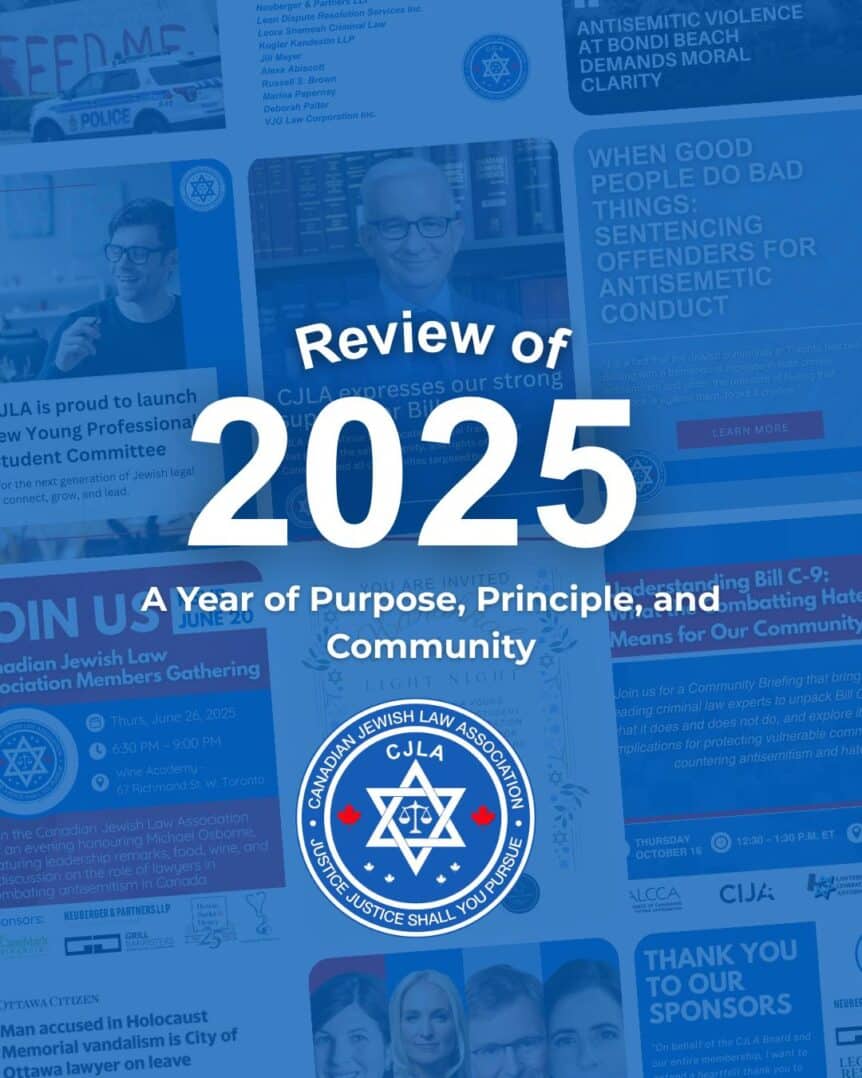
Canadian Jewish Law Association (CJLA) – Year in Review
As CJLA enters 2026, we pause to reflect on a formative first year defined by purpose, principle, and meaningful engagement. From its inception, the Canadian Jewish Law Association was established to serve as a professional home for Jewish legal professionals and allies committed to the rule of law, equality before the law, and the active confrontation of antisemitism, racism, and hate in all their forms.
CJLA’s mission is rooted in the belief that the legal profession carries both professional and moral responsibilities. Lawyers play a critical role not only in administering justice, but in safeguarding the integrity of legal institutions, defending access to justice, and ensuring that discrimination and intimidation are neither normalized nor ignored. Throughout its first year, CJLA advanced these principles through education, advocacy, institutional engagement, and community-building.
This mission-driven approach has resonated. In its inaugural year, CJLA has grown to more than 400 members across Canada, reflecting a strong and growing demand for a national association that brings legal expertise, thoughtful leadership, and a clear voice to issues affecting Jewish communities and the justice system more broadly.
Spring Members’ Gathering and Community Building
In June, CJLA hosted its Spring Members’ Gathering, bringing members together for an evening of connection, reflection, and shared purpose. Held in Toronto, the event underscored CJLA’s commitment to building a strong, engaged national community of Jewish legal professionals.
The gathering honoured Michael Osborne for his leadership and longstanding contributions to the legal profession and to the Jewish community. Members also participated in a thoughtful discussion on the role of lawyers in combating antisemitism in Canada, a theme that has remained central to CJLA’s work throughout the year.
Beyond the formal program, the evening provided an important opportunity for members to connect in person, strengthen professional relationships, and engage in meaningful dialogue in a supportive environment. The Spring Members’ Gathering set the tone for CJLA’s inaugural year, reinforcing the importance of community, mentorship, and collective responsibility.
Education Committee Highlights
Education and professional development were central to CJLA’s work in its first year, reflecting the Association’s commitment to equipping Jewish legal professionals with practical tools, thoughtful analysis, and a strong sense of community.
A major milestone was CJLA’s first national webinar, Justice After October 7: Confronting Antisemitism and Hate – Civil and Criminal Legal Rights and Remedies in Canada. The program attracted over 100 registrants from across Canada, underscoring both the urgency of the subject matter and the need for a dedicated forum to address antisemitism through a legal lens.
The webinar was expertly moderated by Deborah E. Palter, whose steady and insightful leadership guided a focused, respectful, and highly substantive discussion. The panel featured Claire Hunter, Leora Shemesh, and Jamie Spotswood, each of whom brought deep expertise and practical insight to an examination of emerging case law, recent anti-hate legislation, and the challenges of enforcement, deterrence, and access to justice in a post–October 7 landscape.
CJLA’s commitment to rigorous legal analysis was further reflected in the publication of an article by Vice Chair Jeffrey Leon in Thomson Reuters Canada’s Criminal Law Quarterly, examining sentencing trends in antisemitic vandalism and hate-related offences in the post–October 7 context. The article, When Good People Do Bad Things: Sentencing Offenders for Anti-Semitic Conduct in a Post October 7th World, provides a critical analysis of recent Ontario Court of Justice decisions and raises serious concerns about lenient sentencing outcomes that fail to adequately denounce antisemitic conduct or deter future harm.
For CJLA members, this contribution reinforces the Association’s role not only as a convener of education and dialogue, but as a source of thoughtful legal leadership in shaping how antisemitism is understood and addressed within Canada’s justice system.
This inaugural year of programming and scholarship laid a strong foundation for CJLA’s Education Committee, setting the tone for future initiatives that combine substantive legal insight with professional community-building and support.
Training and Institutional Engagement
Throughout its first year, CJLA prioritized meaningful engagement with institutions responsible for public safety and the administration of justice, recognizing that education and training are essential tools in confronting antisemitism and hate.
CJLA assisted with antisemitism training initiatives for police, contributing legal and community-informed perspectives to help law enforcement better understand the nature of antisemitic incidents, the lived experiences of Jewish communities, and the legal frameworks applicable to hate-motivated offences.
In parallel, CJLA has been working collaboratively with the Alliance of Canadians Combatting Antisemitism (ALCCA), Mark Sandler, and the Friends of Simon Wiesenthal Center for Holocaust Studies on the development of antisemitism education and training materials for members of the judiciary, with the goal of delivering these sessions in the near future. This ongoing work is focused on equipping judges with a clearer understanding of contemporary antisemitism, its manifestations in legal proceedings, and the broader societal context in which hate-motivated conduct occurs.
These initiatives reflect CJLA’s belief that confronting antisemitism requires not only strong laws, but informed institutions and legal decision-makers.
Advocacy and Access to Justice
Advocacy and access to justice were core pillars of CJLA’s work throughout its first year. Grounded in the belief that the rule of law must protect all communities equally, CJLA remained actively engaged in supporting individuals and communities affected by hate, discrimination, and antisemitism.
CJLA advocated for victims of hate crime and discrimination, emphasizing the importance of access to legal remedies, fair treatment, and meaningful accountability. At the same time, CJLA recognized the complex legal realities that arise when individuals face criminal charges in the context of confronting antisemitism.
In collaboration with ALCCA and the national criminal law working group, CJLA supported advocacy efforts for individuals charged with offences connected to efforts to combat antisemitism, ensuring that legal principles, proportionality, and due process remain central considerations.
Parliamentary Submissions and Legislative Engagement
Engagement with Parliament and the legislative process was an important component of CJLA’s work in its first year. CJLA prepared and filed written submissions to the Parliamentary Standing Committee on Justice and Human Rights in relation to Bill C-9, the Combatting Hate Act.
CJLA also reviewed and supported detailed submissions prepared by ALCCA, including work led by Mark Sandler, ensuring that the perspectives of Jewish legal professionals were clearly represented in the legislative record.
Through this engagement, CJLA contributed constructively to discussions on hate-motivated intimidation, access to religious and community spaces, and the role of the Criminal Code in addressing antisemitism.
Young Professionals, Mentorship, and Community Development
Developing the next generation of Jewish legal leadership was a key priority for CJLA in its first year. Through an active Young Professionals and Student Committee, CJLA fostered mentorship, peer connection, and professional development for law students and early-career lawyers.
Over the course of the year, CJLA also became increasingly aware of a deeper and more urgent need among younger Jewish legal professionals. In the post–October 7 environment, many reported feeling isolated, alienated, or professionally vulnerable within their workplaces and academic settings as a result of exposure to antisemitic sentiment and hostility. For some, this has affected not only their sense of belonging, but also their confidence and well-being within the profession.
In response, CJLA has begun shaping its young professionals programming to provide not only mentorship and career guidance, but also a supportive professional community where individuals can connect with peers and senior members who understand these challenges. This includes creating space for dialogue, peer support, and reassurance that Jewish legal professionals do not have to navigate these pressures alone.
These efforts reflect CJLA’s broader commitment to ensuring that emerging lawyers are supported not only as professionals, but as members of a community grounded in shared values, resilience, and mutual responsibility.
Partnerships and Community Collaboration
Collaboration with partner organizations was central to CJLA’s work throughout the year. A highlight was CJLA’s joint Hanukkah program with UJA, which brought together members of the legal community for an evening of celebration, reflection, and connection.
CJLA also worked alongside organizations including ALCCA and other community partners to advance shared goals related to education, advocacy, and institutional engagement.
International Engagement and Perspective Building: CJLA Delegation to Israel
As part of its commitment to informed advocacy, CJLA participated in a delegation of Canadian lawyers to Israel, represented by Jeff Leon, Jill Mayer, and Leora Shemesh. The delegation engaged with Israeli legal professionals, government officials, and civil society leaders to gain firsthand insight into legal, security, and societal realities following the events of October 7.
CJLA representatives bore witness at sites directly affected by the attacks and engaged in candid discussions on antisemitism, misinformation, and the responsibilities of legal professionals. The delegation reinforced CJLA’s commitment to speaking clearly, grounding advocacy in firsthand knowledge, and upholding the rule of law.
Looking Ahead to 2026
CJLA’s first year has laid a strong foundation, but it represents only the beginning. As the Association moves into 2026, its focus remains on deepening impact, expanding national engagement, and continuing to provide principled leadership within the legal profession.
CJLA is deeply grateful to its members, founding sponsors, partners, and volunteers whose support has made this work possible. Guided by its mission and strengthened by its growing community, CJLA looks ahead with resolve, committed to ensuring that the law remains a force for justice, dignity, and equality for all.