
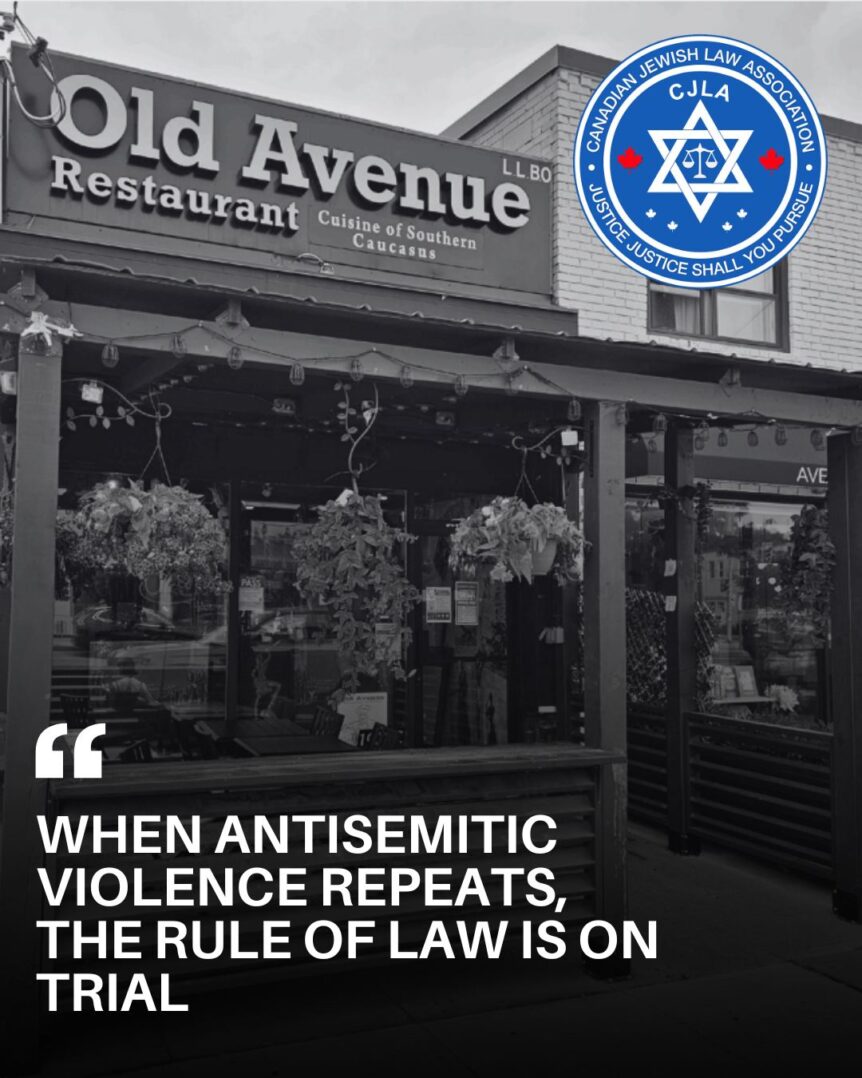
In recent months, Canadian cities, and Toronto in particular, have seen a concerning rise in reported antisemitic incidents targeting Jewish institutions and businesses.
The latest shooting at a Jewish-owned restaurant in Toronto is not an isolated act of vandalism, intimidation, or random violence. It is part of an escalating pattern of targeted attacks reported across multiple incidents in the Greater Toronto Area against Jewish businesses, synagogues, and community institutions that is steadily eroding public safety and testing the credibility of our legal system
Recent accounts indicate that a Jewish-owned restaurant in north Toronto was struck by gunfire in the early hours of the morning. According to coverage, this was not the first such attack involving the same restaurant. In the weeks leading up to Passover, multiple synagogues in the Greater Toronto Area were also hit by gunfire, prompting urgent public concern and a visible increase in police protection around Jewish institutions.
This is where the issue becomes larger than any single criminal investigation.
A society governed by the rule of law depends on something more than statutes, police tape, and public statements. It depends on a shared civic understanding that citizens are entitled to gather, worship, work, eat, and live openly without being singled out for violence because of who they are. When Jewish places of worship are shot at, when Jewish-owned businesses are repeatedly targeted, and when emergency protective measures become normalized around Jewish communal life, the damage extends far beyond broken glass and bullet holes. It alters the conditions of citizenship itself.
The legal significance of that cannot be minimized.
The repeated targeting of Jewish institutions is not only a security problem. It is a rule of law problem. If the law is not seen to meaningfully deter repeated acts of hate-motivated violence, public confidence in legal protection begins to erode. If communities come to believe that they must rely on extraordinary security presence simply to exercise fundamental rights, then the promise of equal protection under the law, including the security of the person and freedom of religion, has already been weakened. Toronto Police have publicly described their Passover deployment as a protective and reassurance effort, but no democratic society should regard heavily guarded worship and community life as an acceptable ordinary baseline.
There is also a broader social cost.
Repeated acts of antisemitic violence do not only frighten those directly targeted. They send a message to the wider public that this form of hatred can recur, intensify, and spread without consequence. They normalize intimidation. They force institutions, families, congregations, and business owners to weigh risk in places where no such calculation should be necessary. Over time, this produces not only fear, but destabilization, mistrust, and withdrawal from public life.
It is also important to recognize the efforts of law enforcement in responding to these incidents. According to Toronto Police, an arrest has now been made in connection with the restaurant shooting, and charges have been laid. We are thankful for the diligence of police services in investigating these acts and taking steps toward accountability. Such actions are essential to restoring public confidence and demonstrating that hate-motivated violence will be met with serious legal consequences.
That is why responses limited to condemnation are not enough.
Criminal investigations must be vigorous and visible. Where evidence permits, prosecutions must be pursued with seriousness. Where patterns suggest ideological targeting, authorities must be prepared to say so plainly and act accordingly. And where current legal tools prove inadequate, legislators and justice system actors must confront that reality honestly. The rule of law is not preserved by rhetoric. It is preserved by enforcement, deterrence, accountability, and the consistent application of legal principle.
Jewish Canadians should not have to prove that repeated gunfire at synagogues and Jewish-owned businesses is a national concern. It is. The repeated targeting of any identifiable community for terror and intimidation is an assault on the legal order itself.
A free society cannot function if one part of the population is expected to live behind barriers, patrols, and reinforced doors while being told that the system is working. History has shown that when targeted violence against one community is left insufficiently addressed, the consequences rarely remain contained.
The question now is not whether these incidents are serious. They plainly are. The question is whether our institutions will respond with the urgency, clarity, and resolve required before this pattern becomes even more entrenched.
The answer matters not only for the Jewish community, but for Canada.